
Swing Education analyzed nearly three school years of substitute requests from K-12 schools across seven states to see when teachers call out and how much notice schools get. Five patterns stood out:
Last-minute absences climb in the fall. They start rising in October and run about 20% higher in November and December than in September.
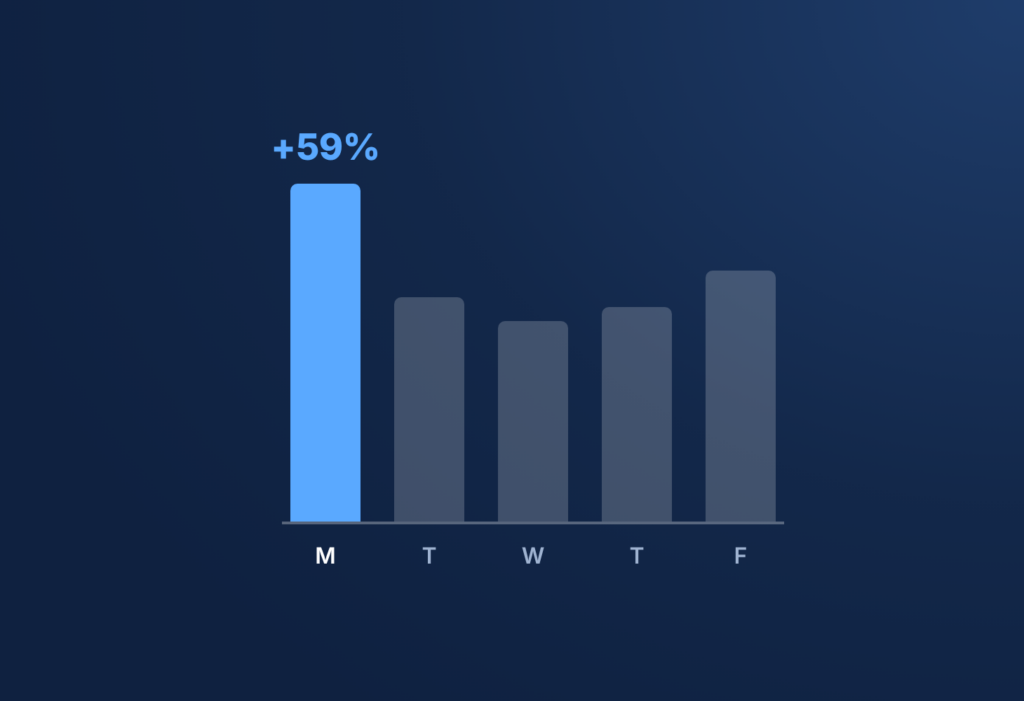
Mondays are the biggest day of the week. In a regular school week, Mondays bring nearly 60% more last-minute absences than a typical Tuesday to Thursday. Fridays bring nearly 20% more.
Long weekends soften the Monday spike. The first day back after a three or four-day weekend runs nearly 25% above a typical midweek day, but well below a regular Monday. The last day before a week-long break runs more than 25% below.
Most short-notice absences come in outside office hours. Nearly 6 in 10 same-day and next-day requests arrive between 5pm and 8am. The busiest hour is 7 to 8am.
Notice is often measured in hours. More than a third of all absence requests (38%) arrive less than 12 hours before the school day starts, and more than a quarter (27%) arrive within 3 hours of the start.
Last-minute absences climb from October through December
Last-minute absences start climbing in October and run about 20% higher in November and December than in September.
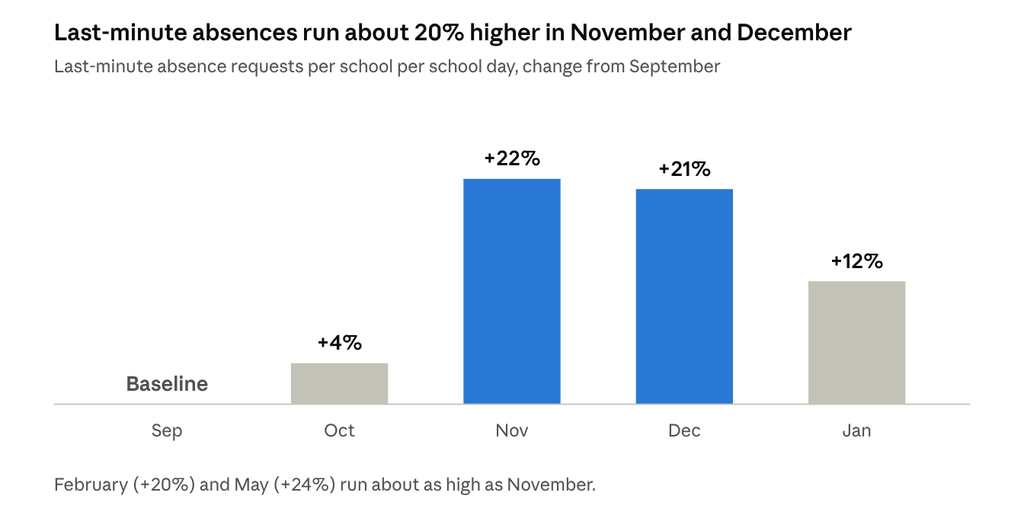
The rise lines up with cold and flu season, when teachers are out sick themselves or home with sick kids. It also arrives quickly: October sits just above September, and the November and December peak follows within weeks. That makes October the month to add subs and line up backup coverage.
Mondays bring the most last-minute absences
In a regular school week, Mondays bring nearly 60% more last-minute absences than a typical Tuesday to Thursday, and Fridays bring nearly 20% more.
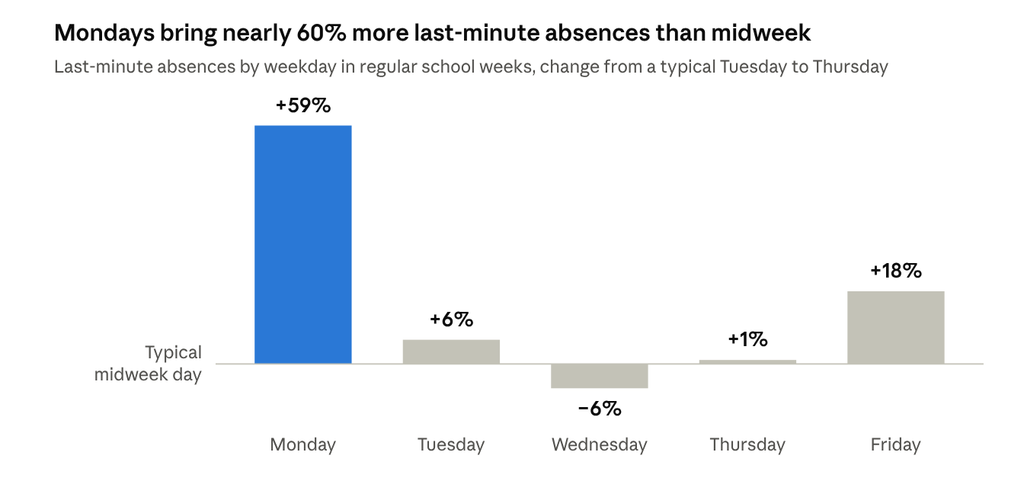
The pattern holds every year in the study, within a few points. Wednesday is consistently the lightest day. For planning, Monday is the best day to have a floating sub booked ahead, especially from November through February.
Most short-notice absences come in outside office hours
Nearly 6 in 10 same-day and next-day absence requests arrive between 5pm and 8am, when most school offices are closed.
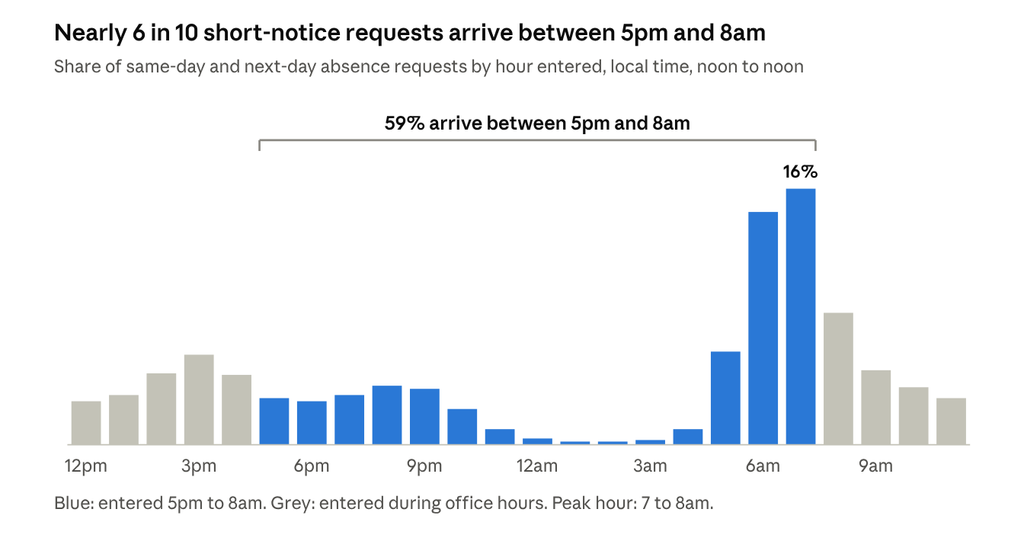
The heaviest stretch is 5 to 8am, when more than a third of these requests arrive. A smaller wave comes in the evening, from about 7 to 10pm, and an afternoon wave comes from teachers who know a day ahead.
Notice is often measured in hours. Across all absence requests, 38% arrive less than 12 hours before the school day starts, and 27% arrive within 3 hours of the start. Swing’s Overnight Absence Management helps sub coordinators cover these late-night and early-morning requests.
Long weekends and breaks soften the Monday spike
The first day back after a three or four-day weekend brings nearly 25% more last-minute absences than a typical midweek day, well below the nearly 60% jump on a regular Monday.
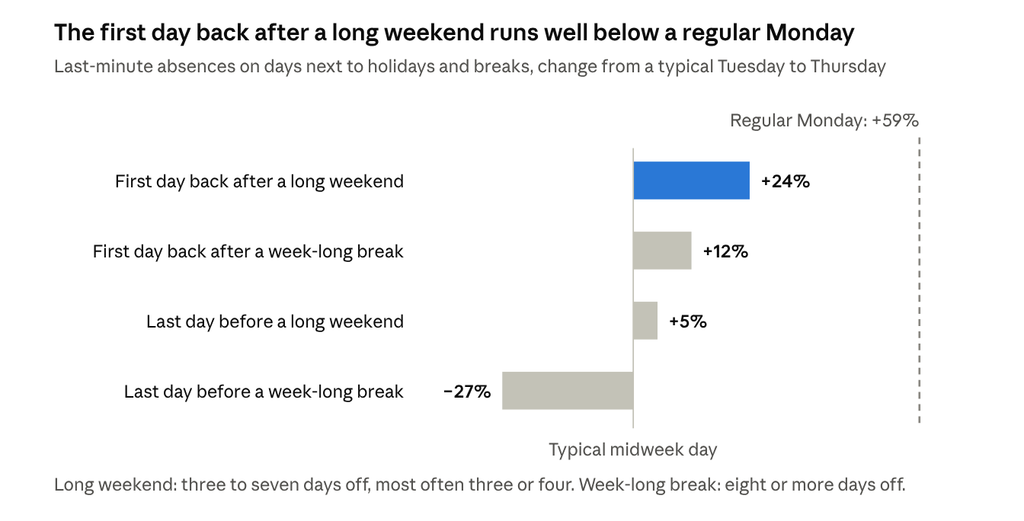
The first day back after a week-long break, such as winter or spring break, lands closer to a normal day. The last day before a week-long break, however, is actually one of the calmest days of the year, and often a shortened day. For planning, the first day back after a long weekend is a good day to have a floating sub on standby, at a smaller scale than a regular Monday.
How schools can prepare for flu season and last-minute absences
Because these patterns repeat every year, most of the planning can happen before the hard days arrive.
- Ask teachers to report absences as soon as they know. Requests entered the day before are filled far more often than requests entered at 6am. A simple norm, like reporting by 8pm when a teacher starts to feel sick, gives subs time to accept before the morning rush.
- Send overnight reports to subs overnight. Most short-notice absences arrive between 5pm and 8am. Connecting your absence management system to your sub service, so each request goes to subs the moment a teacher reports it, puts last-minute sub coverage in motion before the office opens.
- Book coverage ahead for Mondays. A building or floating sub booked in advance can cover whoever calls out. Mondays from November through February are the best place to start.
- Grow your sub list in October. Last-minute absences start climbing in October, so that’s the month to add subs, confirm who is available, and line up backup for November and December.
- Keep emergency sub plans ready. A ready plan lets an administrator or another teacher step into a class smoothly on the mornings when coverage is tight.
- Learn your own patterns. Every district’s calendar is a little different. Looking at your own absences by month, weekday and time of report shows where your gaps are most likely to land.
Frequently Asked Questions
When do teacher absences peak during the school year?
Last-minute absences start climbing in October and run about 20% higher in November and December than in September. February and May run about as high as November, so the fall rise is one of several busy stretches in the year.
What day of the week do teachers call out sick the most?
Monday. In regular school weeks, Mondays bring nearly 60% more last-minute absences than a typical Tuesday to Thursday. Friday is the second busiest day, and Wednesday is the lightest.
What time do teachers usually report absences?
Mostly outside office hours. Nearly 6 in 10 same-day and next-day requests arrive between 5pm and 8am. The busiest stretch is 5 to 8am, and a smaller evening wave runs from about 7 to 10pm.
How much notice do schools get when a teacher calls out sick?
Often just a few hours. 38% of absence requests arrive less than 12 hours before the school day starts, and 27% arrive within 3 hours of the start. Another 22% arrive the day before, and 40% arrive more than a day ahead.
Do teacher absences go up after holidays and long weekends?
Yes, by less than a regular Monday. The first day back after a three- or four-day weekend runs nearly 25% above a typical midweek day, and the first day back after a week-long break about 12% above. A regular Monday runs nearly 60% above.
How do school districts handle same-day teacher absences?
Most same-day absences arrive before the office opens: nearly 6 in 10 same-day and next-day requests come in between 5pm and 8am. Common approaches include an absence management system that sends each request to subs the moment it’s entered, floating or building subs booked ahead for the heaviest days, and emergency plans that let an administrator or another teacher cover a class.
How can schools prepare for substitute shortages during flu season?
Start in October, when last-minute absences begin to rise. Add subs to your list and confirm who’s available before November, book floating coverage for Mondays from November through February, ask teachers to report absences the evening before when they can, and make sure overnight reports reach subs right away.
How can districts improve substitute fill rates for last-minute absences?
Start with timing. Requests entered the day before are filled far more often than requests entered the morning of, so ask teachers to report absences as soon as they know, ideally the evening before. Send overnight reports to subs right away, book floating coverage ahead for Mondays and the November to December stretch, and keep emergency sub plans ready.
How we measured this
- Source: substitute requests from K-12 district and charter schools in California, Texas, Arizona, Illinois, New York, New Jersey and Washington, DC, covering the 2024 – 2026 school years. Requests capture the absences schools needed a substitute for, so they show the shape of short-notice absences more than a school’s full absence count.
- Notice: the time between when a request was submitted and the start of the assignment, in the school’s local time. “Last-minute” means less than 12 hours’ notice.
- Months: last-minute requests averaged per school per school day, each month compared with September, then averaged across the three school years. December figures vary by a few points depending on how pre-break half days are counted.
- Weekdays and holidays: measured in districts that requested coverage on nearly every school day, so their requests trace their school calendar. Each day is compared with the same district’s typical Tuesday to Thursday in the same month. A regular Monday follows a two-day weekend; a long weekend is three to seven days off, most often three or four; a week-long break is eight or more days off.
- Time of report: same-day and next-day requests (under 24 hours’ notice) that school staff entered directly, grouped by the local hour they were entered. Requests sent automatically by absence management systems are left out of this view because their timing follows each system’s sync schedule.
About Swing Education
Swing Education helps K-12 schools cover substitute teacher and paraeducator absences in California, Texas, Arizona, Illinois, New York, New Jersey and Washington, DC. For short-notice absences, Swing’s last-minute sub coverage includes overnight absence management, extra sub pay when a sub cancels late, and roving and floating subs. Swing has managed nearly 2 million substitute requests since 2014.
See your own absence patterns. Swing’s free Absence Insights Report looks at your district’s absence records and shows where coverage gaps are most likely to land this year, so you can plan before the busy weeks arrive. Get your Absence Insights Report